---
title: "Reality Bytes: How Long Does a Website Actually Take to Build?"
url: "https://radiantweb.co.za/blog/how-long-does-a-website-take-to-build/"
type: "post"
published: "2026-11-02T14:40:42+02:00"
modified: "2026-11-02T15:32:00+02:00"
author: "Website Maintenance - Level 2"
---
# Reality Bytes: How Long Does a Website Actually Take to Build?
- [November 2, 2026](https://radiantweb.co.za/blog/2026/11/02/)
Table of Contents
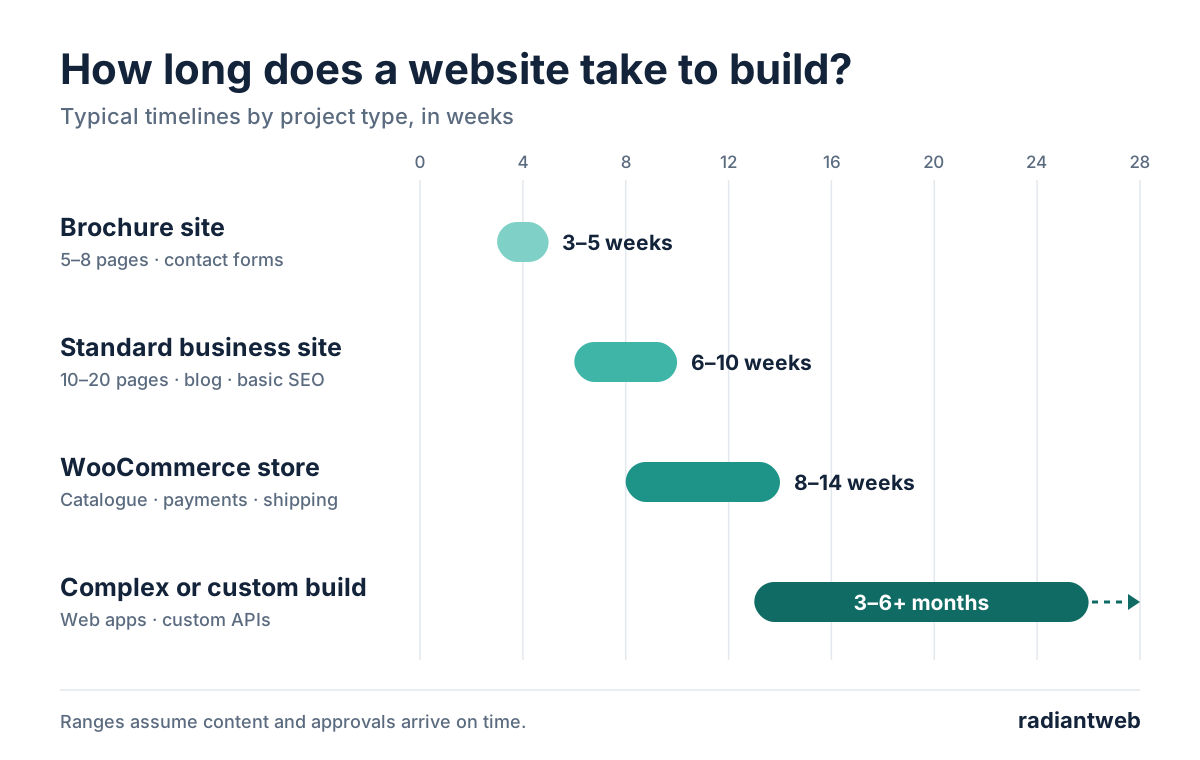
The first question almost every client asks is: how long does a website take to build? Most people expect an answer in days. The honest answer is weeks, not days: most professional business websites take 3 to 14 weeks to build, and complex custom builds take 3 to 6 months or more.
That’s because coding is only one part of the job. A realistic website build timeline also covers collecting content and brand assets, rounds of design feedback, choosing the right platform and testing everything before launch. The website development process in South Africa follows the same stages as anywhere else, and each one takes time.
We’ve built WordPress websites for businesses in South Africa and abroad since 2012. Below is what actually sets the timeline, what happens in each phase, and what you can do to keep your project on track.
## AI website builders vs WordPress: Choosing your tech stack
Your choice of platform sets the starting point for your timeline. An AI-generated site can go live in minutes, while a fully custom build with advanced functionality, bespoke design and new content can take one to six months.
Measured in hours of work, the spread looks like this:
- **AI-generated site:** under an hour of your time.
- **Small business site you build yourself:** roughly 20 to 40 hours, spread over a few weeks.
- **Custom build by a developer:** hundreds of hours.
### 1. AI website builders: fast, but rigid
When comparing an AI website builder vs WordPress, nothing beats AI for speed. You can have a first layout in minutes. The trade-off is control. These platforms work well for a basic landing page, but changing a complex layout or adding a unique feature later is often impractical. If the site can’t grow with your business, the time you saved upfront is lost when you have to rebuild.
### 2. WordPress and custom builds: slower, but built to scale
A professional WordPress website timeline scales with what the site has to do. WordPress gives you a solid, open-source framework, but custom layouts, client portals and specialised plugins all need careful configuration and testing. That work is what keeps the site stable, secure and easy to extend for years to come.
## How long does it take to build a website?
Timelines by project type
Every business has different requirements, so treat these ranges as guidance, not fixed promises. They assume content and approvals arrive on time; the next section explains why that matters.
## What Happens During a Website Build: The 5 Phases
Knowing what each phase involves makes it easier to see where time goes. Here’s how a standard 6–10 week business website breaks down:
1. **Discovery and planning (about 1 week).** We agree goals, pages, features and the sitemap. Clear decisions here prevent most of the scope creep later.
2. **Design (2–3 weeks).** Wireframes set the layout of key pages, then full designs apply your branding. This is where most revision rounds happen.
3. **Development (2–3 weeks).** The approved designs are built in WordPress, with forms, plugins and any integrations set up and configured.
4. **Content, testing and compliance (1–2 weeks).** Final copy and images go in. We test on mobile, tablet and desktop, check page speed, and make sure the privacy policy and cookie consent meet POPIA requirements.
5. **Launch (a few days).** The site goes live, redirects from any old site are put in place, and the site is submitted to Google Search Console.
Phases can overlap. Content can be written while the site is designed, which is one of the easiest ways to save time.
## The Root Causes of Project Delays
Most overruns don’t come from slow coding. They come from dependencies: the build can’t move forward until something arrives or someone makes a decision. These five cause most delays.
### 1. Content and copy aren't ready
This is the biggest single cause of delay. A build can stall for weeks waiting for approved copy, high-resolution product photos or brand assets such as logos, colour palettes, wordmarks and favicons. Without them, pages can be designed but not finished.
### 2. Slow decision-making
Every approval that has to pass through several people adds days. When wireframes or structural choices sit in an internal review queue, the whole project waits with them.
### 3. Rolling revision rounds
Design iterations are part of the process. The problem is feedback that arrives in pieces. One consolidated round of feedback can be done in a week. Feedback that trickles in over ten days, followed by a stakeholder who missed the earlier calls asking for changes in week three, turns that week into a month.
### 4. Third-party integrations
Connecting local payment gateways such as [PayFast](https://payfast.io) or [Yoco](https://www.yoco.com/za/), syncing a CRM or linking an ERP system for inventory brings in systems outside the developer’s control. Each one needs its own setup, test transactions and fixes, and can depend on the provider’s response times.
### 5. Scope creep
Agreeing what you need at the start keeps deadlines realistic. Each “just one more page” adds design, content and testing time, and those additions add up quickly. A new feature added midway can mean reworking parts of the site that were already built, which pushes everything after it back.
## How to keep your website project on schedule
Most of these delays can be avoided before the build begins. Before your project starts:
- Gather your copy, photos and brand assets, or agree firm dates for delivering them.
- Name one decision-maker who collects internal feedback and signs off each stage.
- Send feedback as one consolidated list per revision round.
- Bring every stakeholder in from the first review, not the last.
- Agree the scope upfront and park new ideas for a second phase.
- Have logins for your hosting, domain, payment gateway and CRM ready early.
## The solution: Why a time range beats a fixed date
When an agency gives you a time range instead of a fixed launch date, that’s a sign of honest planning, not vagueness. A range allows for testing, feedback rounds and the real-world variables above. A fixed date tends to slip the first time content runs late.
Planning properly for those variables is what produces a site that’s secure, optimised for search engines and built to grow with your business.
## Frequently asked questions
How long does it take to build a WordPress website?
A brochure site of 5–8 pages usually takes 2–4 weeks. A standard business site of 10–20 pages with a blog takes 6–10 weeks. Both assume content and feedback arrive on time.
How long does it take to build a WooCommerce store?
Most WooCommerce stores take 4–8 weeks. Payment gateway setup, product uploads and shipping rules add time beyond a standard business site, and large catalogues take longer.
Can a website be built in a week?
Yes, if it uses an AI builder or a ready-made template and all the content is ready. A custom-designed site can’t be properly designed, built and tested in a week.
What delays a website project the most?
Waiting for content. Unfinished copy, missing photos and brand assets stall more projects than anything else.
Is a website redesign faster than a new build?
Not always. A redesign also needs existing content reviewed and moved, and redirects set up so you don’t lose your Google rankings. Plan for a similar timeline to a new build of the same size.