

Checkout psychology is shaping how people are buying online in 2026. Online shoppers are becoming wiser, so understanding their key emotional triggers is essential for driving conversions and growing your Ecommerce business.
New studies have shown that creating a more engaging and practical online shopping experience for your customers, which speaks to their emotions positively, goes a long way in determining a positive outcome that will not see them abandoning their shopping cart anytime soon.
Why Has Checkout Optimisation Become a Matter of Checkout Psychology Rather Than Purely Technical Design?
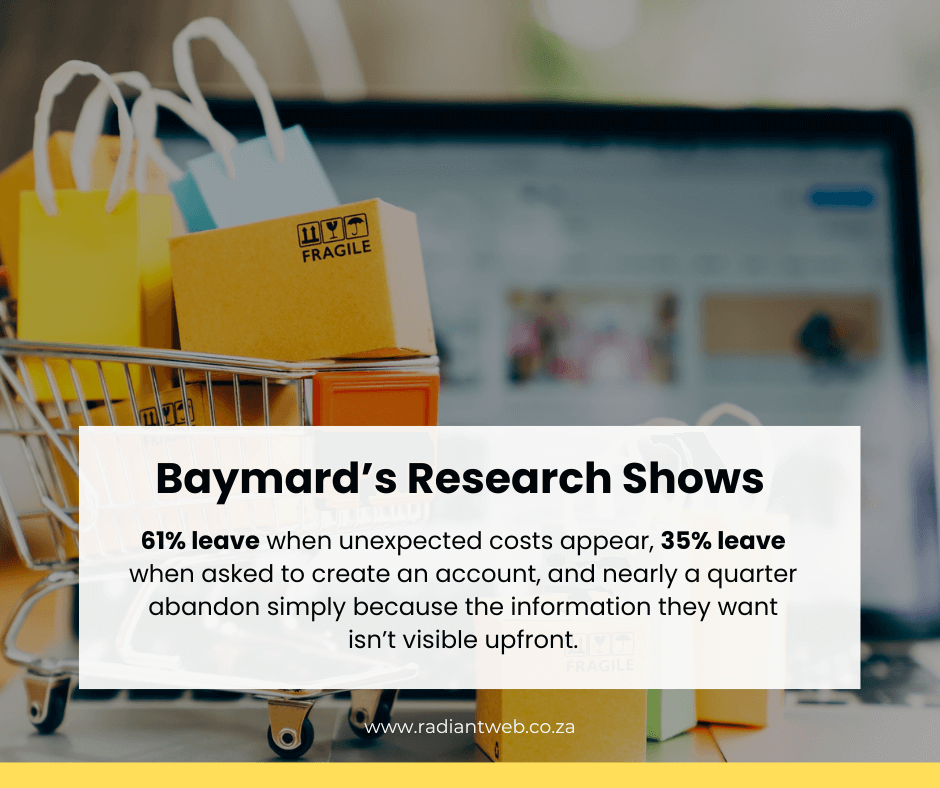
As more research finds out more about our behavioural patterns, the root cause as to why people abandon their shopping cart can be traced back to human psychology. A recent study by Baymard has uncovered valuable research that shows 61% of online shoppers leave when unexpected costs appear, and that 35% leave when asked to create an account, while nearly 25% abandon simply because the information they want isn’t visible upfront.
What this has uncovered is that underneath those stats the following human responses are core to understanding how our minds work emotionally when shopping and parting with money. These include:
- Uncertainty
- Fear of missing the deal
- Decision fatigue
- Fear of commitment
A modern checkout has to speak to all four of these human concerns as a collective and currently the most effective ones do it dynamically rather than with static screens. Here are six simple guidelines you can incorporate into your Ecommerce website.
1. Loss Aversion Built Into the Layout
One of the most powerful mental triggers in retail remains loss aversion, or what we all commonly know in other aspects of our life as FOMO (fear of missing out). This is rooted in the tendency to avoid losing something more strongly than the desire to gain it which is one of the most common types of checkout psychology.
In real-life shopping, this comes in the form of ‘limited time’ stands near point of sale (tills) or loyalty discounts you might lose out on by not swiping your shopping card. However, in Ecommerce, the new trend is something far more subtle: persistent value framing inside the checkout itself.
The main focus is on retaining customers by highlighting what they will gain upon finishing the checkout, rather than dwelling on the total cost. An example of this comes in the form of a crossed-out original price of a product that stays visible throughout the entire shopping flow, reinforcing the belief that the discount is a temporary possession at risk.
When someone hovers toward closing the tab, a micro-copy update will instantly remind you that ‘you’re saving R240 today, keep my discount’, which feeds that mental FOMO impulse.
It doesn’t shout. It reframes the moment as preserving value, not parting with money. This quiet psychological lock-in increasingly separates the modern trend-setting checkouts from the old ‘apply coupon’ era.
2. Real Product Scarcity, Not Manufactured Urgency
In real-world retail creating a sense of scarcity feels immediate: like one jumper in your colour left on the rack or only one pair of shoes in your size. In digital form, however, the urgency used to mimic this is fake countdowns and generic ‘Only 3 left!’ banners, which customers grew bored of and learned to ignore.
But the new trend we are seeing that is already emerging across advanced WooCommerce setups, is credible, product-specific tension. When stock is genuinely low in a selected size, customers see: ‘Only 1 left in medium, high demand today’.
Because it’s honest, the psychological impact is stronger. Humans treat competition signals seriously when they feel authentic. Nothing is invented. There is no countdown, just real-time, size-aware availability. That keeps urgency from feeling manipulative, a key evolution in 2026 Ecommerce ethics.
3. The Personal Shopper Nudge
Choice overload is the digital equivalent of standing in a supermarket aisle staring at forty types of cereal. Your brain is overwhelmed, you start looking at pricing and value but your brain stalls, rendering any proper decision-making that triggers you to leave it and move on.
Some WordPress e-commerce stores use predefined product suggestions or AI-powered product recommendation tools to personalise suggestions at checkout. These tools analyse customers’ browsing behaviour and cart contents to recommend relevant complementary items – and many stores configure recommendations to show only a small number of high-relevance items instead of a long catalogue. This kind of personalised upselling and cross-selling can improve user experience and potentially increase average order value.
It behaves like a good shop assistant who suggests: ‘You’re buying a camera, why not consider this memory card, which fits perfectly.’ Buyers move faster when the cognitive load drops. This isn’t upselling disguised as psychology. It’s removing decision noise so the customer can confidently continue.
4. How Free Shipping Incentives Can Influence Purchase Decisions
One of the most powerful psychological nudges is to return a favour. Humans instinctively return value when they feel they’ve been given something. Physical shops use this by offering samples or small freebies. Online, however, there is the dynamic free-shipping ladder, which comes in the form of a progress bar.
This is strategically set so that the remaining amount appears small and achievable. A friendly reminder that you’re only R46 away from free delivery nudges customers to add one more item rather than pay for shipping. It’s a subtle prompt that increases basket value for the store. Instead of paying for delivery, they’re effectively getting an extra item at no additional cost.
This is effective because it reframes adding an item as reducing a cost rather than increasing a spend. Some stores extend the mechanism with a timed mini-reward: a free sample unlocked if checkout is completed within 10 minutes.
5. How Frictionless Payments Work At Checkout
Customers rethink most deeply at the moment of commitment. Any friction magnifies the doubt. This is why 2026 WordPress checkouts are structurally simpler:
- One-tap payments like Shop Pay and Click to Pay are offered upfront
- Buy Now, Pay Later sits inside the mini-cart
- Address fields autofill before the customer even reaches them
- Single-page layouts dominate
None of this feels futuristic on its own, but the psychology behind it is. Every micro-decision is removed before the customer recognises it existed. Momentum stays intact because the brain never hits a red light.
6. How To Use Social Proof To Increase Conversions
Physical retail thrives on presence. Seeing other shoppers validates your own behaviour. Ecommerce is catching up by adding a subtle layer of social activity that is highly effective. A clever reminder to the buyer that they are part of a wider buying audience situated in their immediate area nudges them to make a purchase.
These quiet, geo-aware message notifications like: Someone in Cape Town purchased this four minutes ago’, triggers the brain’s impulse. It’s a little nudge that mimics the gentle buzz of a busy shop, a reminder that the customer is part of a wider buying moment. If placed near checkout, its effect is magnified and it lowers that psychological barrier to final commitment.
Understanding The Psychology Behind Checkout Choices
Ecommerce and online habits have evolved over time. Shoppers are becoming wiser and are able to detect when outdated gimmicks are used. They are more likely to respond to mental aspects that trigger uncertainty, FOMO, decision fatigue and a fear of commitment.
By understanding checkout psychology you need to focus on those human triggers as a collective. Shoppers are evolving faster than most checkouts. They’re more sensitive to mental effort, quicker to detect insincerity, and more comfortable with interfaces that respond to their behaviour instead of being dictated to.
Checkout psychology isn’t about bold designs or elaborate pathways. It’s about creating a checkout that feels psychologically attuned to creating momentum early; ensuring clarity when there is hesitation; offering reassurance at the commitment phase; and most importantly preserving value even after the purchase has been made.
Understanding this is essential for growing your Ecommerce business. By applying tactics outlined in this blog, you can create a more engaging and practical online shopping experience for your customers.