
Elementor is the most widely deployed WordPress page builder, active on roughly 12.8% of all websites globally – including millions of sites that outrank competitors built with custom code. But market share doesn’t make Elementor a safe default choice. The platform is SEO-neutral and performance-neutral: a professionally built Elementor site can achieve Core Web Vitals scores that meet Google’s ranking benchmarks; a poorly built one will fail them, regardless of content quality or domain authority.
For most business websites – lead-generation focused, eCommerce, or content-driven – Elementor provides the design control of custom development at roughly 40–60% of the cost, with delivery timelines of four to eight weeks rather than three to six months. The businesses that don’t benefit from Elementor are those requiring complex custom application logic or bespoke database architecture. For everyone else, the platform question matters far less than the agency question.
This guide covers what professional Elementor development actually looks like, how it differs from a DIY or template build, and where the platform’s genuine limitations sit.

What is Elementor and why do professional agencies use it?
Elementor is a visual drag-and-drop page builder that runs on top of WordPress, allowing designers and developers to build fully customised page layouts without writing code for every element. Unlike closed platforms such as Wix or Squarespace, Elementor operates on self-hosted WordPress, which means businesses retain complete ownership and control of their website, data and hosting environment.
Elementor Pro – the paid version of the platform – extends this with a Theme Builder, WooCommerce Builder, dynamic content capabilities, a popup builder, and access to a library of professionally designed templates. When paired with an SEO plugin such as Rank Math or Yoast SEO, Elementor gives agencies full control over heading structure, meta titles, schema markup, breadcrumbs and page hierarchy — all of which are foundational to strong search engine performance.
Professional agencies use Elementor because it combines design flexibility with development efficiency allowing them to deliver visually polished, technically robust websites in a fraction of the time that custom-coded builds would require, without sacrificing code quality or long-term scalability.
What types of businesses benefit from Elementor web design?
Elementor is well suited to a wide range of business types. Its flexibility means it can handle everything from simple brochure sites to complex lead-generation systems, eCommerce stores and membership platforms. Businesses that typically benefit most from a professional Elementor build include:
- Corporate and professional services firms that need a polished, on-brand presence with structured service pages and clear user journeys
- B2B technology and SaaS companies that require flexible landing pages, case study sections and integration with CRM and marketing automation platforms
- eCommerce businesses using WooCommerce, where Elementor’s WooCommerce Builder allows bespoke product pages and checkout flows without custom development
- Lead-generation businesses that rely on conversion-focused landing pages, enquiry funnels and downloadable resources to attract and capture prospects
- Agencies and membership platforms that need scalable content architecture — adding new pages, resources and functionality over time without rebuilding from scratch

Why professionally built Elementor websites outperform DIY builds
Elementor’s accessibility is one of its strengths, but it is also the source of a common misconception: that because the interface is drag-and-drop, any competent person can build a high-quality website with it. In practice, the gap between a DIY Elementor build and a professionally developed one is significant — and it tends to widen over time.
Common problems with DIY Elementor websites
When businesses build Elementor websites without professional development support, three problems appear consistently: Page speed is one of the most common. Without proper performance optimisation – image compression, script management, lazy loading, and the use of a content delivery network (CDN) – Elementor sites can become heavy. This directly affects Core Web Vitals scores, which Google uses as a ranking signal, and increases bounce rates among mobile users.
SEO structure is another frequent weakness. Many DIY builds have inconsistent heading hierarchies, missing schema markup, poorly structured internal linking and meta data that hasn’t been set up correctly in Rank Math or Yoast. These are not cosmetic issues – they limit a site’s ability to rank for competitive search queries regardless of the quality of the content.
Finally, DIY builds often suffer from plugin bloat. Elementor has a large ecosystem of third-party add-ons, and many non-developers install multiple plugins to achieve effects that a professional would build natively. Each additional plugin introduces a potential performance hit, security vulnerability and compatibility conflict. Sites built this way frequently need a full rebuild within two to three years.
What a professional Elementor agency does differently
An experienced Elementor agency approaches a build with a systems mindset. Before a single page is designed, the site architecture is mapped out: URL structure, internal linking strategy, heading hierarchy, and the relationship between pillar pages and supporting content. This structural work is what determines whether a website can rank and scale, and it is almost always absent from DIY projects.
Professionally built Elementor websites also use clean, minimal code. Agencies with Elementor expertise know which native widgets to use, how to avoid render-blocking scripts, and how to configure caching and performance plugins such as LiteSpeed Cache or WP Rocket to achieve fast load times. Well-optimised Elementor websites consistently achieve strong Core Web Vitals scores and pass Google’s PageSpeed Insights benchmarks without significant trade-offs.
The result is a website that performs well from launch and remains maintainable without specialist developer knowledge. Pairing a professionally built Elementor site with an ongoing WordPress website care plan ensures the site stays secure, updated and performing at its best long after launch – without placing that burden on your internal team.
Elementor vs custom WordPress development vs templates:
Which is right for your business?
This is one of the most common questions businesses ask when planning a new website, and the honest answer is that the best choice depends on the complexity of the project, the available budget and the intended lifespan of the site.
| Elementor (Pro Build) | Custom WordPress Dev | Template-Based (Wix / Rigid Theme) | |
|---|---|---|---|
| Typical cost | Mid-range | 2–3× more than Elementor | Lowest upfront; recurring platform fees add up |
| Delivery timeline | 4–8 weeks | 3–6 months | Days to weeks |
| Design flexibility | Full - every element controllable | Full | Limited by template logic |
| SEO control | Full - headings, schema, meta all configurable | Full | Partial - platform-dependent |
| Post-launch editing | Marketing team can manage without a developer | Developer required for most changes | Easy, but constrained to template options |
| Scalability | High - add pages, templates and integrations without rebuilding | High | Low - hits ceiling quickly |
| Switching cost | Medium - layouts are Elementor-specific; content is portable | Medium–High | Medium - content portable, design is not |
| Best suited for | Most business websites: lead-gen, eCommerce, content-driven | Complex web apps, SaaS platforms, bespoke logic | Micro-businesses needing a fast, low-budget presence |
Fully custom WordPress development
Custom development – building a WordPress theme entirely from scratch without a page builder – offers the highest possible level of technical control. There are no third-party dependencies, no plugin ecosystems to manage and no design constraints imposed by a builder’s rendering engine. For highly specialised web applications, complex SaaS platforms or data-driven systems with unique logic, custom development is often the right answer.
However, custom development is expensive, slow and creates significant developer dependency. Minor design updates require a developer. New landing pages require a developer. Any iteration on the site’s layout requires a developer. For most business websites whose primary job is to generate leads, build authority and support marketing campaigns, this overhead is difficult to justify. Custom development also typically costs two to three times more than a professionally built Elementor site for equivalent output.
When custom development may be the better choice
While Elementor is the right choice for the majority of business websites, but there are genuine cases where custom development is the more appropriate solution. These include highly specialised web applications with complex custom logic, SaaS platforms with bespoke user interfaces, data-driven systems requiring non-standard database interactions, and projects where technical performance requirements are so demanding that any abstraction layer – including a page builder – would introduce unacceptable overhead.
For most professional services firms, B2B companies, eCommerce businesses and content-driven organisations, however, Elementor provides more than enough flexibility and control. The key is working with an agency experienced enough to build it properly.
Template-based websites
At the other end of the spectrum, template-based websites – whether built on a rigid WordPress theme or a platform like Wix – offer low cost and fast launch at the expense of flexibility. Templates enforce their own design logic, which means genuinely differentiating the site’s layout, visual identity or user journey requires fighting against the template rather than building freely. These sites also tend to hit a scalability ceiling quickly: adding new types of content, building custom landing pages or integrating with business systems typically requires either significant compromise or a full rebuild.
Elementor: The practical middle ground
Elementor occupies a uniquely practical position between these two extremes. A professionally built Elementor site gives businesses the design freedom of custom development – every layout element is fully controllable – at a significantly lower cost and with a much shorter development timeline. Projects that would take three to six months with custom development can typically be delivered in four to eight weeks with Elementor, without sacrificing quality.
Crucially, Elementor also gives businesses the ability to manage and expand their own website after launch. Marketing teams can create new landing pages, update copy and add content without needing a developer for every change. This independence is one of the platform’s most commercially valuable characteristics, and it is one of the primary reasons professional agencies recommend it for growing businesses.
Within the WordPress ecosystem, Elementor’s most credible competitors aren’t templates or custom development — they’re newer page builders like Bricks Builder, Oxygen, and Breakdance. These tools have gained significant traction in developer communities since roughly 2022, primarily on the argument that they produce cleaner, lighter code than Elementor.
The honest comparison: Bricks Builder and Oxygen do produce leaner output in the hands of an experienced developer. The trade-off is a steeper learning curve, a smaller plugin ecosystem, and fewer agency-trained developers available in the market. For businesses working with a small or single-developer studio, these tools can be excellent choices. For agency-scale projects requiring a team of developers, Elementor’s standardised workflow, larger talent pool, and more mature plugin integrations maintain a practical advantage.
The bottom line: if your agency uses Bricks Builder with expertise, that’s a credible choice. If they use Elementor with expertise, that’s equally credible. Platform matters less than implementation quality.
Is Elementor good for SEO? Building search-ready WordPress websites
Elementor is frequently mischaracterised as an SEO liability. In practice, Elementor is neither good nor bad for SEO by itself — it is a neutral tool, and search performance depends almost entirely on how the site is built and configured. High-ranking WordPress websites use Elementor successfully at scale, and there is nothing in the platform’s architecture that prevents a site from competing for competitive search queries.
What matters for SEO on an Elementor site is the same as on any WordPress site: clean heading structure (one H1 per page, logical H2 and H3 hierarchy), correct use of schema markup via Rank Math or Yoast, a fast and mobile-responsive design, strong internal linking, optimised images with descriptive alt text, and well-structured URLs. A professional Elementor agency builds all of these into the site from the start rather than retrofitting them after launch.
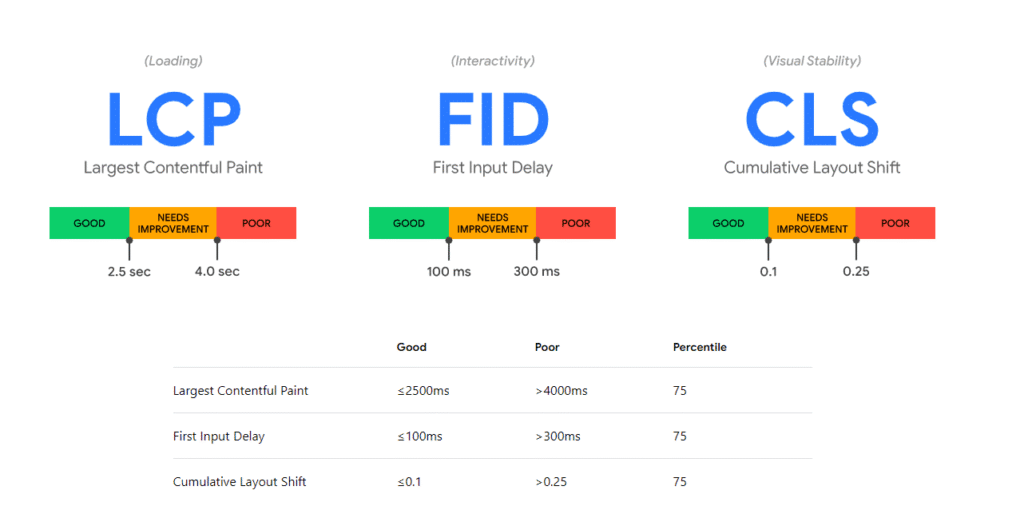
Page speed is the area where Elementor sites most often underperform in SEO audits, and it is almost always a development quality problem rather than a platform problem. Google’s Core Web Vitals – which measure Largest Contentful Paint (LCP), Interaction to Next Paint (INP) and Cumulative Layout Shift (CLS) – are confirmed search ranking signals. A professionally optimised Elementor site, using WebP images, lazy loading, minified scripts and a performance-focused hosting stack, can consistently meet or exceed these benchmarks.
Performance optimisation for Elementor websites
Research published by Google’s Think With Google found that a one-second delay in mobile page load time can reduce conversions by up to 20% -a figure that has informed mobile performance benchmarks across the industry since its publication. For a business website generating leads or processing transactions, that is a measurable commercial cost.
Elementor sites can achieve excellent performance scores, but doing so requires deliberate technical choices at every stage of development. At the image level, this means converting all assets to modern formats such as WebP, implementing lazy loading so images only load when they enter the viewport, and using correctly sized images rather than relying on CSS to scale down oversized files.
Integrating Elementor with CRM, marketing and business systems
Native WordPress integrations and dedicated plugins allow Elementor-built sites to connect with the platforms most growing businesses already run: HubSpot, Salesforce, Zoho CRM, ActiveCampaign, Mailchimp, Stripe, Xero, Google Analytics 4, and WooCommerce Payments – without custom API development or middleware. For businesses that have invested in a CRM or marketing automation stack, this means the website can become an active participant in the sales and marketing process rather than a passive brochure.
A professional Elementor agency will map these integration requirements at the start of a project and architect the site to support them from day one, rather than bolting on integrations after launch. This upfront planning prevents the compatibility problems and performance issues that arise when integrations are added to an existing site that was not designed to accommodate them.
Elementor as a long-term scalable platform
One of the most important qualities of a business website is that it can grow alongside the business. A website that needs to be rebuilt every two or three years because it has hit a design or technical ceiling is not an asset – it is a recurring cost.
Elementor’s architecture supports long-term scalability in a way that template-based websites cannot match. New service pages, landing pages, case studies, content hubs, and microsites can all be added without disrupting the existing site structure. Global design tokens — fonts, colours, button styles, spacing rules — are managed centrally in Elementor Pro’s Global Settings, which means a rebrand or design refresh can be applied site-wide without rebuilding individual pages.
Elementor itself is actively maintained and regularly updated by a large development team. According to Elementor’s own platform data, the plugin has been downloaded over 300 million times and maintains a dedicated team focused on performance, security and new features. Because it is built on WordPress — which powers over 43% of all websites globally according to W3Techs – businesses are not locked into a proprietary platform. If an agency relationship ends, the site can be handed to any WordPress developer and maintained without specialist knowledge.
Conclusion: Elementor web design that works for your business
Elementor has evolved from a simple drag-and-drop page builder into a mature, professional website development platform used by millions of businesses worldwide. When built by an experienced Elementor agency, it delivers websites that combine strong visual design, technical performance and long-term scalability — at a cost and timeline that custom development cannot match.
The businesses that get the most from Elementor are those that approach their website as a long-term commercial asset: investing in professional development at the outset, maintaining and expanding the site as the business grows, and treating search visibility, conversion performance and technical health as ongoing priorities rather than one-time concerns.
If you are considering a new website or a rebuild, the most important question is not which platform to use — it is who builds it and how.
Website Development starts with a comprehensive plan to cover all the essentials your online business needs. Chat with us about your requirements.
Frequently asked questions about Elementor
Is Elementor good for business websites?
Yes. Elementor is well suited to most business websites, including corporate websites, lead-generation sites, ecommerce stores and content-driven websites. It provides extensive design control while allowing businesses to add and update pages without requiring a developer for every change.
Can an Elementor website scale as a business grows?
Yes. Elementor can support the long-term growth of most business websites. New pages, landing pages, case studies, content hubs and integrations can be added without rebuilding the entire website. Elementor Pro’s global settings also allow design elements such as fonts, colours and styles to be managed centrally.
Is Elementor good for SEO?
Yes. Elementor itself is neither an SEO advantage nor a disadvantage. SEO performance depends primarily on how the website is structured and optimised. A professionally developed Elementor website can use proper heading structures, schema markup, internal linking, optimised URLs, responsive design and performance optimisation to support strong search visibility.